Showing posts with label donor centric. Show all posts

Friday, July 11, 2014

What Does the Donor Hear?

I loved cartoonist Gary Larson. It was a sad day when he retired in 1995. One of my favorite cartoon panels was "What we say to dogs". There we go. Barking out commands to our canine friend, fully expecting that he hears and understands every word. Even raising our voice to ensure we are understood. What hubris! What the dog hears is it's name. That's it.

Sasha Dichter of the Acumen Fund cleverly illustrated the parallel between "dog/human" and possible "non-profit/donor" communication.

As Sasha wrote, "I wonder if we could re-title this cartoon 'our needs', as in: every time we regale someone with 'what we need' we remember all they're hearing is 'blah blah blah blah.' But whenever we say their name, whenever we paint them into the picture, whenever we make them a part of the story, they hear us loud and clear.

If you agree with the notion, rather than thinking tactically how to make this shift by 'changing your pitch', you might instead ask yourself who's keeping you from actually seeing the person across the table as an integral part of the story...because she is."

Amen,  Sasha! The donor is more likely to hear you if the presentation or case is more about them. It's like hearing your own name. And everyone loves to hear their own name.

Thursday, July 3, 2014

Other mistakes that undermine your web fundraising

Last time I wrote about the "beginner" mistakes that undermine your web fundraising. This time I will cover the more intermediate mistakes that cost you online donations.

1. No Benefit for the Donor
If your website is all about what a wonderful non-profit you are, all your achievements, all your programs, you sound just like most other mediocre websites, whether charitable or commercial. If, on the other hand, you communicate what your organization can do for the donor, you immediately separate yourself from the pack. As with successful direct mail text, use the words “you” and “your” often. Your website should not appear to be a snare to catch a gift, but a tool for the donor to achieve his or her philanthropic goals.

2. No Urgency
Make it clear why the donor must do something now. What are the implications if they delay? Perhaps even set a deadline. “We need to raise $xxxxx by xx date in order to ensure children are fed.”

3. Colors Blend In
Does your call to action stand out or are you enslaved by corporate brand guidelines? Fundraising is often about creating action out complacency. It is hard to do that if everything is subject to the tyranny of a non-intrusive color palette. Your “donate” button should be big, bold and assertive. Your call to action statements should stand out. Tell the snarky designers to apply their sacrosanct brand guidelines on a nondescript brochure. You need to make sure your case for giving literally vibrates on your web page.

4. No Credibility
Donors are not only concerned about ensuring that their gifts are well used but also that they appear to be savvy philanthropists.  They don’t want to look like fools to their peers. They want to give to organizations that are winners. Nothing cuts through the “Who are these people?” question better than donor profiles, complimentary quotes by supporters, or the logos of recognizable corporate sponsors. Use them.

5. Loaded with Jargon

Sometimes it’s fun to use big words that make you look smart, right? Maybe, but it is a terrible fundraising tactic. Few but your own employees will understand highly technical industry jargon. Simple words work best when trying to persuade someone to take action.

Apply these elements and see your website giving soar.

Wednesday, May 14, 2014

7 "beginner" mistakes that undermine your web fundraising

A couple of years ago Jeff Brooks referenced on his blog, Future Fundraising Now, a post from  Copyblogger regarding unfortunate content mistakes that undermine website sales. Jeff noted how these same issues could easily be applied to fundraising websites. Here are the first seven "beginner mistakes":

1. No Call to Action
Optimizing, tweaking, beautifying your website is nearly fruitless (from a fundraising perspective) if you don't ask for a gift.

2. Below the Fold
Web visitors shouldn't have to scroll down to see your call to action. State your case and ask for the gift in the upper portion (above the fold) of the screen.

3. Not Authoritative
Tell your readers exactly what you want them to do, and do so with conviction.

4. Not Specific
Don't make it a guessing game. Spell out exactly what you want your visitors to do. Give, sign-up, share, like, etc. Make it easy, make it clear.

5. Too Much Self Proclaimed Hype
Tooting your own horn comes off as so much puffery and bloviating. A third party endorsement is much more effective.

6. Multiple Calls to Action
What's the most important thing you want your visitor to do on your website? This is often very difficult since we are tempted to provide the vast array of things we do as nonprofits and present all the things we want the visitor to do as a result. People are often stymied by choice and they end up doing nothing. Prioritize.

7. Puny Call to Action
As the Copyblogger author states, "I've never seen a website call to action that is too big."

In the next post I will share what Copyblogger regards to be the more "advanced mistakes". In the meantime, go back over your website and see if you have committed any of these rookie blunders.


Wednesday, May 7, 2014

Growing Philanthropy Part 3: Identifying New Audiences, Channels, and Forms of Giving with Strong Potential for Growth

Encourage the adoption of monthly giving. Monthly giving has so many benefits for charities and donors that I am always amazed at how few nonprofits promote this option. Per Sergeant and Shang, the lifetime value of supporters giving in this way is estimated to be 600 to 800 percent higher than "non-sustainer" donors. They note that younger donors prefer monthly giving because it is considered more convenient and environmentally friendly, requiring less renewal and reminder mailings. Donor retention is far higher for sustaining donors as well. It's a no brainer.

Improve the sector's engagement with young people. Promote giving at an early age and help develop a "giving habit". Utilize new digital media such as digital applications, virtual environments, gaming platforms, and social networking. Find ways to make it easy, affordable, and enticing to include them in the philanthropic process.

Encourage and promote best practices in social media. Traditional giving channels still significantly outperform online giving, and social media accounts for only just over 10 percent of that small portion. Nonetheless, social media has a huge potential to greatly increase a supporter's engagement, and engagement is the key to healthy giving. Social media also has the potential to build donor commitment, trust and loyalty. But it must be done well. This is a great opportunity for an astute nonprofit since so much social media based fundraising is done so poorly.

Encourage asset-based giving. 93 percent of American wealth is made up of stocks and non-cash assets such as real estate, business interests, and personal property. Charities are "missing the boat" if they are solely focused on chasing the 7 percent cash available. Provide easy means for donors to contribute asset-based resources.

Improve the quality of bequest fundraising. Although 80 percent of Americans will support the nonprofit sector during their lifetimes, only 8 percent will provide for charities in their estates. Sergeant and Shang believe part of the challenge is that charitable bequest solicitation has been relegated solely to the planned giving departments at nonprofits. They suggest that soliciting bequests should receive wider and broader communication and informational materials be accessible and employed by all staff.

Leveraging companies to promote philanthropy. Since many individuals spend most of their waking hours at work, provide opportunities in the workplace to educate employees about charity missions and outcomes. It must be more than simply a card table and brochures set up in a lobby. One nonprofit had launched a campaign to address obesity and set up a fajita bar at a local business to teach workers how to prepare healthy fare. They effectively hammered home their brand, their goals, and addressed latent objections such as proper dieting is no fun.

Although Sergeant and Shang's report included other recommendations, they concluded with this insightful statement, "Instead of viewing donors as a source of revenue and maximizing the value of that relationship, they (nonprofits) need to focus more on the individual and the articulation of that person's philanthropy. Only when we stop asking for money and instead ask for individuals to reflect on their own philanthropic identity will the needle truly be moved on giving."

Let's move the needle.

Thursday, May 1, 2014

Growing Philanthropy Part 2: Developing Public Trust

The second finding that Sargeant and Shang suggested in their whitepaper, Growing Philanthropy in the United States, is the necessity to develop public trust and confidence in the fundraising sector. They state, “Organizations are the conduit by which donors fulfill their own aspirations. Donors don’t give to organizations but through organizations.” The disconnect that Sargeant and Shang see is that, as charities become more focused on removing financial risk, enhancing effectiveness, and employing more proven fundraising techniques, the process becomes more mechanistic. The donor can be viewed as, and feels like, a “piggy bank” rather than a partner in the cause. I believe some of this is the result of a rather corrosive, if initially well-meaning, emphasis by industry watchdog organizations on the percent of funds spent on program versus fundraising costs. I believe this puts undue pressure on nonprofits to squeeze as much revenue out of each transaction as possible.

Sargeant and Shang propose that nonprofits must see supporters as more than simply donors, but they should be regarded as “individuals with their own philanthropic aspirations and goals.” They suggest that donors may not even be aware of what their goals truly are and that it is the responsibility of the organization to “find new and creative ways through which individuals can discover and express their own philanthropic identity and thus experience the joy of giving.” They admit that this sort of identification on the charity’s part would require a greater degree of donor research and necessitate additional staff time, expertise and cost. All at a time when the aforementioned “program vs. fundraising” metric is being put forth as a litmus for what is a “good charity” worthy of donor investment.


Additional recommendations include:

Empower regulators to enforce 100 percent filing of Forms 990 and increase their utility.  Include more narrative that would focus on the outcomes achieved by the nonprofit thus shifting the emphasis from efficiency to effectiveness.

Blow the whistle on organizations claiming to have zero cost of fundraising. Recent research found that 59 percent of organizations did not claim any fundraising expenses. Come on! How can you believe anything a charity reports with this sort of blatant info manipulation?

Fund the development of a website in the United States to educate the public, boards, and other stakeholders. “There is gross misunderstanding in the public as to how nonprofits work. Many Americans still believe the sector is populated largely by volunteers, that managers are paid poorly (if at all), and that income can be generated at zero (or close to zero) cost.” It is critically important to communicate how nonprofits really work.

Encourage nonprofits to develop complaint schemes.  Many organizations are hesitant to create complaint schemes for fear of raising false expectations about their ability to resolve issues. Good complaint handling boosts loyalty. In fact, there is some indication that resolving a problem successfully creates greater loyalty than being problem free.

Fund the development of a website to facilitate peer-to-peer evaluations of nonprofits. Much like the comments and ranking sections on commercial online sites such as Amazon, providing a forum for donor commentary and evaluation may well inspire more people to give.

Develop new and more appropriate measures of performance. Watchdog groups such as Guidestar, Charity Navigator and Charity Watch place far too much emphasis on charities demonstrating what tends to be stifling efficiency standards rather than organizational effectiveness. Nonprofits need to be proactive and help define what is effective and better articulate the investment needed to achieve mission outcomes.

Develop the self-regulation of fundraising. The key concerns of the public appear to be:
  • A perception of an “excessive” volume of communication
  • The quality and tone of that communication
  • The use of enclosures in mail
  • The use of inappropriate or shocking imagery
  • Data errors in the communication
  • A sense of intrusion, created by the media employed for the message
Sargeant and Shang claim no one has yet addressed these issues properly. They recommend a greater focus on the development and promotion of professional standards or the creation of a body that would accredit good quality fundraising in a similar way that the Better Business Bureau accredits good business practices.

Wow! We have a lot of work to do. And we're not through all of Sargeant and Shang's recommendations or themes.

Next post I'll review their third theme, Identifying New Audiences, Channels, and Forms of Giving with Strong Potential for Growth.

Monday, April 28, 2014

Growing Philanthropy

As mentioned in my March 20th blog post, back in June of 2011, fundraising experts Adrian Sargeant and Jen Shang from the School of Philanthropy at Indiana University published a report presented by Blackbaud, entitled Growing Philanthropy in the United States. Their research had found that, despite increasingly sophisticated fundraising practice, the development of sophisticated planned giving vehicles, the appearance of the Internet, and the rise of new digital channels, giving as a percentage of average household disposable (after tax) income has been static at 2% for at least 40 years. This, despite the increased level of human need presented as a challenge to nonprofits.  The number of natural disasters has tripled since the 1960s, the number of armed conflicts almost doubling during this period, one in six Americans are challenged with hunger and one percent of Americans are homeless.

Sargeant and Shang’s findings were reviewed at the Blackbaud 2011 Nonprofit Executive Summit and the conclusion of the participants included the following needs within the industry:
  • Enhance the quality of the donor relationship
  • Develop public trust and confidence in the fundraising sector
  • Identify audiences, channels, and forms of giving, with strong potential for growth
  • Enhance the quality of fundraising training and development

For the next four posts I will share additional details of each of these findings. First, addressing the donor experience:


Enhance the quality of the donor relationship
  • Understand donors have their own philanthropic aspirations and goals and find new ways for them to express their own philanthropic identity
  •  Go beyond maximizing the donors gift to your organization and develop the philanthropy of your supporters
  • Allow donors to have greater control over their giving relationship
  • Enhance focus on retention of donors by building the loyalty of supporters, since a 10% increase in retention can result in a 200% improvement in lifetime value of a supporter
  • Breakdown organizational silos and encourage greater collaboration between teams
  • Reduce high turnover rates (30% per annum) in the fundraising profession, often caused by CEOs and Board members who value their own limited personal experience or “gut feel” more than they do the accumulated fundraising body of knowledge, so that meaningful relationships have time to develop
  • Educate stakeholders about the necessity of a longer term and integrated approach to fundraising

I know many of these issues have been the topics of industry webinars and conferences. But how much progress has been made over the past three years since Sargeant and team published their report? I dare say, not much. Certainly, the lingering effects of the recession have prevented many organizations from indulging in what they may feel is the luxury of donor relationship building. Tight budgets may have reduced opportunities to invest in any activities beyond bare-bones solicitation. Unfortunately, failing to make progress regarding the foregoing issues has a direct impact on current fundraising success and the next blog posting topic - Developing public trust and confidence in the fundraising sector. 

Until then…

Tuesday, March 25, 2014

Is Your Job To Serve Or To Sell?


Back in 2011,  one of my favorite fundraising blogs, Passionate Giving, penned by major giving experts Jeff Schreifels and Richard Perry, posted about a new year's resolution they suggested all fundraisers adopt for that year. Make sure you are serving your donor, not selling them. Jeff shared an experience he had in an Apple store when it was clear, to his chagrin, that he could have been easily "sold" a solution to a computer problem he had by chucking his old computer and upgrade to a more expensive and newer model, but wasn't. He asked the salesperson why he wasn't trying to sell him a new iPad? The salesperson's said he was there to make his experience the best it could be, show him the product and let the product sell itself. He added, "We don't get commission on sales. It is all about serving the needs of the customer." Jeff continued, "I didn't buy the iPad that night, nor were they able to fix my software problem (it was a Microsoft product), but I left feeling so good about my experience that I can't think about NOT buying an Apple product in the future."

Do our donor interactions leave them with the same sort of feeling? If the moment was not right to make a gift, do they walk away feeling they couldn't even think about NOT giving to our organization when they are ready to contribute? If our objective is to sell them, put another notch in our "closed deal belt", then it will likely fail. Serving our donor demands more listening, research, and interaction. It will be necessary to unearth what our donor's goals or interests are that need to be served.  It must be more than just identifying financial capacity or finding out about their other philanthropic giving.

Listening, really listening, demands putting aside our egos and our objectives and really concentrating on the prospect. Listening, not to find a window to "pounce" but to find a connection between what our organization does and how that aligns with the donor's aspirations. Listening. So important, and seemingly so hard to do. Which reminds me of a fantastic TED talk by deaf Scottish percussionist Evelyn Glennie titled "How To Truly Listen". But that is for another post.


Thursday, March 20, 2014

Back to the Future

Roger Craver, one of the founders of the fundraising agency Craver, Mathews, Smith & Co, currently provides insights through his fundraising blog, The Agitator. Back in 2011 he posted an article titled The Future of Fundraising. It was based upon Blackbaud’s recently released report Growing Philanthropy in the U.S.  The report contained reams of helpful recommendations and insights. A lot has happened since 2011. Osama Bin Laden is off’d, Occupy Wall Street begins, Muammar Gaddafi is killed, the Sandy Hook massacre takes place, the Japan tsunami wrecks havoc, Prince William and Kate Middleton marry, and NASA’s Mars rover detects evidence liquid water once flowed on the red planet. Where stands fundraising? Were the Blackbaud recommendations heeded? You be the judge.

Here are a few of the top takeaways from the report and Craver’s analysis (minus some of his entertaining but salty language):

•     Redefine Relationships. Stop being selfish. Focus on giving for giving’s sake.

•     Re-orient toward longer-term measures of fundraising performance. Immediate measure of ‘success’ (response rates, immediate ROI, giving totals for the year) doom us. Look at long-term values.

•     Enhance focus on retention and building supporter loyalty.  Listen up! With retention rates in the dumper too few nonprofits really understand that a 10% improvement in retention results in a 200% improvement in lifetime value.  Time to get real.

•     Develop a more integrated approach to fundraising. It’s not the method, stupid, it’s the message. And the message must focus on the donor’s concerns, not yours.

•     Break down organizational silos and encourage greater collaboration between teams. The authors are too kind to say it, but you should be ashamed of your territoriality.

•     Give supporters greater control over the relationship. Ken Burnett, The Agitator, DonorVoice and scores more have been preaching this for years. This is the arena where you can quickly add the most value.

•     Tackle high turnover rates in the fundraising profession. Face it. It’s not the pay it’s the lack of respect from CEOs and board members that drives folks out of this trade. We have an identity crisis and have to deal with it.

•  Educate all stakeholders about the necessity of a longer term and integrated approach. I know, I know, it’s like playing Mozart to a cow, but we have to do it. It’s a real challenge, but we must not allow Boards to be stupid about fundraising, stewardship and philanthropy.

•     Empower the regulators to enforce 100 percent filing of Forms 990 to increase their utility. Hey, I know this seems picky, but the fact is that some organizations don’t file, some lie, some don’t.  Transparency is key to the future of philanthropy. Get with it.

•     Blow the whistle on organizations claiming to have zero costs of fundraising. As long as watchdog organizations reward ‘zero’ costs, organizations will lie. It’s time to call out the phonies in the watchdog groups and blast the nonprofits that play this game. There simply ain’t no thing as ‘zero’ fundraising costs.

•     Encourage nonprofits to develop complaints schemes. Anyone who knows anything about donor retention and commitment is familiar with the importance of feedback. (See http://thedonorvoice.com)  This report reminds us of the absolute necessity to provide multiple methods for donor feedback.

•     Develop new and more appropriate measures of performance.  Efficiency and cost of fundraising sucks as a measurement of anything.  There are far more appropriate measures.

•     Develop the self-regulation of fundraising. Ethics be damned.  There’s a whole host of scumbags out there. But, we can do something about them.

•     Encourage the adoption of monthly giving. Serious Monthly Giving or Sustainer programs produce 600% – 800% more revenue. Get to it. Now!

•     Encourage and promote best practices in social media.  Importance of social media isn’t $, it goes to building loyalty and commitment.

•     Encourage asset-based giving. The Report claims that 93% of a person’s giving potential is realized with a bequest or other planned gift.  Get at it!

•     Improve the quality of bequest fundraising practice. Death is our friend. But, with at least 8% of our donors willing to make a bequest, this just has to be taken out of the incompetent (marketing-wise) hands of planned giving officers and placed in the hands of those capable of selling.

•     Redesign the system of professional development and certification for fundraisers. Important stuff here. Knowledge and understanding of donor behavior is key for the future, not the number of AFP merit badges.

•     Educate board members about the intricacies of fundraising.  Among all the barriers to successful fundraising and philanthropy, the ‘board’ is the mightiest barrier and pain. This report rightly targets the boards for education and improvement.


I’d say all of these would make the list of priorities for 2014.  What say you?

Sunday, July 14, 2013

It may not be exciting, but it's essential!

I have worked with many nonprofits that have one or two really exciting programs and a plethora of important but not particularly energizing initiatives. The problem often is that it is fairly easy to raise donations for the sexy program but far more difficult to create interest in operational or foundational needs.

Often too, the program that generates all that interest may have a more modest budget and can be fully funded far too quickly. What to do then? How can you turn the more bland, cream-of-wheat initiatives into philanthropy magnets? Well, maybe you can't. Some aspects of your operations may never be attractive to Joe and Jennifer Bigbucks. But what if you can create a compelling "umbrella" that all that critically important but lackluster activity in need of financial support can fit under? 

Let's take an animal welfare organization as an example. A tremendous amount of money is spent on maintenance - food, heat, a/c, rent or mortgage, gas for vehicles, salaries, etc. A relatively smaller amount of money is spent on the more moving adoption services. What if you positioned all the operational activities as being handmaids of adoption. What if you profiled the individuals that you never hear about that utilize all those mundane duties and show how they are critically important to getting those animals adopted. The case and ask includes the broader actions and costs but they are shown to be indissolubly linked to that persuasive niche element. The mundane is thereby raised to a much higher and more exhilarating level. You keep the entire ship afloat and you ensure that the "gripping" program has an organization to support it.

Tuesday, December 25, 2012

I Resolve to...


A year ago January, the Advancement Best Practices LinkedIn Group asked their members to list their fundraising resolutions or goals for 2012. Here is what they answered:

42% Build a philanthropic culture
20% Link metrics to ROI
17% Engage trustees/ CEO
16% Identify new potential donors
5% Not one of the above

I think it is interesting that the top goal was to build a philanthropic culture. You would think that was a given for anyone working for a nonprofit. The fact that it was yet to be built, (not even simply improved), says something about the state of our business. If a nonprofit or charity doesn't have philanthropy at the core of what they do, how are they surviving? How are they connecting with and motivating their donors? By coercion? Yikes!

According to Guidestar, up to 60,000 nonprofits fail each year and in 2010 8% claimed they were in imminent danger of going under. Why?

I think the lack of a philanthropic culture is part of the problem. But more importantly, there is a fundamental misunderstanding as to how and why donors give. Here is what nonprofit leadership must understand:

  • The heart is more important than the head. Executive Directors and Boards are often embarrassed to present the emotional side of their story. They want to "convince" the donor that they are a good "investment". Leave the investment up to the bank. Your charity or nonprofit most likely grew our of a compelling need. Don't forget that. 
  • You must ask to receive. The classic "If we build it they will come" is hooey. If you don't ask, someone else will -- and they will get the donation.
  • Everyone in your organization must be comfortable with the fundraising process. I have heard some fundraisers say, "Everyone in our organization is a fundraiser". I don't buy that. Fundraising is a skill forged from experience and an art born of personality. Not everyone is good at it nor do they have to be. If this wasn't so, why would we hire fundraisers? But the entire staff should understand how it works, if only to support the efforts of the fundraising team. The one thing that can kill an organization is an employee who is constantly denigrating the fundraising process.
  • Take advantage of every avenue to raise funds. There are 1.5 million nonprofits in the US. That's a lot of competition. Make it easy for the donor to give to you through the channels they prefer. You must have an annual fund program, solicit major gifts, make use of social media and e-philanthropy, create profitable events, accept planned gifts, and keep abreast of whatever is working for other organizations.
  • Test, test, test. Be fiscally prudent but don't be afraid to take risks. Risk can often be reduced by testing. I am constantly astounded to find experienced nonprofits that fail to test fundraising approaches. 

There are certainly other elements of successful fundraising. As the survey identifies, link your metrics to return on investment. (This is especially true of events. I am sure many organizations would be shocked if they included direct and all indirect costs in their event profitability assessment.) Engaging trustees and all leadership in the mission as well as the fundraising process is helpful. And yes, finding new donors is important. But, I would have ranked "steward current donors exceptionally well" ahead of prospecting and that isn't even listed! Your most valuable donors are the ones who have already provided you with a gift.

What are your resolutions for 2013? I will list mine in my next post.

Saturday, November 10, 2012

Going That Extra Mile

How often have you experienced someone going "above and beyond"? It seems to be a rare occurrence these days, especially in a retail experience. (I don't think the mindless, robotic response, "Can I help you find something" thrown your direction by a busy salesman as they speed past you on their way to the mysterious "back room" counts.)

When it does happen, when you find yourself in front of someone who gives you their full attention, who really seems to want to help - and knows how to - it can give you tingles.

A number of months ago, Sasha Dichter, intrepid blogger and Chief Innovation Officer at the Acumen Fund shared a story of one such experience he had at an Apple store. His salesperson's name was Hakiem and his post was a letter of thanks addressed to him:
Dear Hakiem,
I know everything at the Apple Store is  designed to  be techno-blissful, but you really took things to the next level. Not only did you shake my hand, make me feel welcome, and help me get a Genius Bar appointment in less than five minutes, but you managed to make me feel just a little bit less bad about dropping my iPad on 6th avenue and cracking the screen (and I was feeling REALLY bad). 
I was already appreciative of you for that, but then as I was walking up 9th avenue, you ran out of the store and up to 15th street and stopped me to make sure that my problem had been solved. Wow. 
I bet you go above and beyond every day for folks, and I'm sure they appreciate it more than you know. I'll be sure to tell everyone who goes to the Apple Store at 4th and 9th in New York City to look out for you.
Okay. Why don't we all provide this sort of care and service? It has incredible impact just because it is so infrequent. And it really didn't take much for Hakiem to do it. Probably no more than a couple of minutes to run down the street and make sure Mr. Dichter was satisfied.

Think about how much time we spend in the fundraising profession researching, cultivating, soliciting -- hours and weeks, even years. And yet, we often overlook the truly personal and momentous act of going "above and beyond" that is not only very gratifying for the prospect, but it makes us feel so good as well.

Do it. Go the "extra mile" because it is so rarely done. Do it because it is the right thing to do. Do it for how it makes you feel. Our profession needs it. And frankly, the world needs it.


Saturday, October 6, 2012

Quote of the Week: Building a Culture of Philanthropy

"Donors are not considered a means to an end, but just as vital as the work you carry out meeting the worlds greatest needs." 
Jeff Schreifels 

The Passionate Giving blog is launching a six part series about how to build a culture of philanthropy at your nonprofit. The brains behind The Passionate Giving blog, Jeff Schreifels and Richard Perry, know their subject well. They have over 55 years of experience fundraising for nonprofits such as Oxfam, The Salvation Army, World Harvest Mission, and United Cerebral Palsy.

Here are the key elements mentioned in their first blog post that they state must be part of an organization intending to build a vibrant culture of philanthropy:

  • The mission of the organization includes donors.
  • The leadership of the organization and the entire staff embrace the idea that fundraising is essential in fully carrying out the work and that it brings joy to donors to  give.
  • Board members are your biggest cheerleaders.
  • It's hard to tell who is working in "program" and who is in "development".
  • Donors of the organization trust it.
  • Everyone in the organization knows "the story".
  • When anyone walks through the doors of the organization what is felt is love, empathy, righteous anger, grace, hard work, personal care, and...more love.
Here are my comments regarding these excellent points:

- I am not sure I have ever seen a nonprofit mission statement that includes donors. (If you have one that does I would love to see it.) What a great idea! 

- Although most nonprofit employees will grudgingly admit that fundraising is a "necessary evil", fewer accept the need for everyone to participate in the fundraising process, and still fewer believe that true philanthropists delight in giving.

- If board members are not your biggest cheerleaders, should they be on the board?

- Too often staff and program people see themselves in completely different worlds. How often have you heard program people speak disparagingly about "the suits", or development people complain of the unrealistic demands of the field staff? An organization with a flourishing culture of philanthropy respects each other's work and worth. 

- A nonprofit will not survive if there is no trust.

- Does everyone at the nonprofit have the same vision, a sense of the mission, a passion for the organization's core story regarding why it exists? Do they appreciate the incredible impact it is having on their community or even the world? Is it a culture where each employee can't wait to go to work each day?

- Walk through your door some day with the mindset that you are a new visitor. How are you greeted by the first person you see? What kind of small talk happens in the hallway, in the lunchroom, around the water cooler? Is it whiny and critical or is it filled with positive enthusiasm. Office atmosphere has a way of creeping into all that you do, even your interactions with your supporters. Make sure it is filled with the same optimism, care, and compassion you bring to your mission.

These are great ways to ensure that your organization is fostering a culture of philanthropy. Be sure to check out the Passionate Giving blog for their next five installments.


Friday, September 21, 2012

Quote of the Week: YOU are awesome!


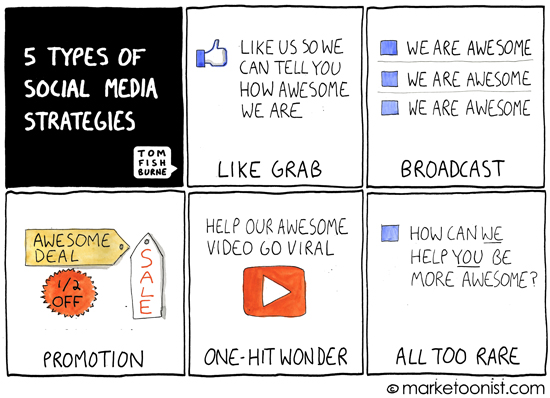
I saw this great cartoon from the Marketoonist site authored by Tom Fishburne with the title 5 types of social media strategies - (by way of Jeff Brooks' Future Fundraising Now blog). 

Some of the most cutting and insightful commentary on modern marketing comes by way of the artistic wit of Mr. Fishburne. Fundraiser Jeff Brooks notes in his own blog's commentary on this 'toon that the self-absorbed, self-focused approach so often promoted on social media platforms must be avoided by fundraisers -- and all marketers, really.

Repeat after me- It's all about the donor. It's about how we can help them feel awesome. It is how awesome they ARE. 

Thursday, September 6, 2012

Are You Creating Pablum?

Pablum - the ultimate pejorative? 

Actually, Pablum was a breakthrough medical product created by a team of Canadian pediatricians in the 1930s to prevent rickets, a crippling childhood disease. It was a vitamin packed and digestible mush made from a mixture of ground and precooked wheat, oatmeal, yellow corn meal, bone meal, dried brewers yeast, and powdered alfalfa leaf -- all fortified with reduced iron. 

Sounds yummy, doesn't it?

Pablum had everything these doctors knew would be good for sick or at risk babies. And it seemed to help. So what if it tasted like wallpaper paste! It was good for you!

How interesting that pablum has come to define worthless, oversimplified, insipid or bland communication or information. Perhaps the problem with this sort of communication is similar to what might have been going through the minds of those well-meaning pediatricians eighty years ago. They might have been more focused on solving the problem at hand then in making the product appealing. In their instance, that might be justified. For a charity today, it is not.

Are we more focused on making sure the recipient of our messages or solicitations is informed about our great need than making our message compelling? Is it more important that the reader understand what is important to us -- our charity -- than for us to find a way to connect with the reader or donor's interests? Is that the reason for so many uninspired "wish lists", droning "opportunities to give", and endless tomes harping on needs, rather than stirring stories of actions and outcomes?

Let's think about what inspires and motivates us. Is it incessant begging and cajoling? Or, is it that rare and rousing tale from the heart that touches us and moves us to make a difference?

Oh, and it should be noted that Pablum became even more commercially popular when the manufacturer added flavored versions. 

Imagine that.


Friday, August 24, 2012

Post Direct Mail Fundraising


Direct mail is still the king of fundraising. Despite the incessant drumbeat of speculation that direct mail  is on the wane, dying, or already dead, it is still responsible for 75% of all fundraising revenue for a typical nonprofit (source: Blackbaud 2011 donorCentrics Benchmarking Report). 

By the way, bad direct mail should be dead. With a stake in its heart!

Personally, I believe that the most successful fundraising strategies include a multifaceted approach. Coordinated campaigns that include complimentary direct mail, online, social media, telefundraising and personal solicitations are proving to be extremely effective.

But what would post-direct mail fundraising look like? Are alternatives to direct mail dependent campaigns really working for certain charities?

Is post-direct mail fundraising already here and does it looks like Charity:Water?


Tom Belford of the Agitator blog recently asked regarding Charity:Water's September campaign Is this any way to launch your annual appeal? He answered with a definitive "You bet it is!" And Beth Kanter recently posted about Charity:Water's brilliant use of Instagram. 

The following video hints at why Charity:Water is so successful, why it connects so strongly with donors on an emotional level, and how it utilizes electronic media so well.


September Campaign 2012 Trailer: Rwanda from charity: water on Vimeo.

The video tells a great story and illustrates how Charity:Water is a key part of the story. But it has the astuteness of understanding that Charity:Water, the nonprofit, is not the story. It is all about the people of Rwanda. It is their story. The story is told clearly and simply. It promises that if you - the donor - partner with Charity:Water you can help ensure the story ends well.

Paull Young, Charity:Water's Director of Digital Engagement, recently summed up their approach this way:
  • ask supporters to give up their birthdays, offering a great experience in return
  • focus on sharing great content, not asking for money
  • make the campaigner the hero, not the organization
  • strive to have a ten year relationship with constituents
  • rely 100% on social media and online platforms with no direct mail
This approach seems to be working extremely well for them. Charity:Water raised over $8.6 million in 2009 and over $16 million in 2010. All without utilizing direct mail.

Let's take a look at how they do it online. Click on this link for their September Campaign 2012. 

Charity:Water leverages the web beautifully. An arresting first frame of an embedded video takes up nearly half of the page. Towards the top of the page is a progress bar showing how much has been raised so far and what the ultimate goal is. Under this first video titled "The Trailer" you see there will be four other videos that can be viewed on August 28, September 4th, 7th and 11th. These are tempting teases encouraging the visitor to return to the site. Naming the lead video The Trailer makes it seems like a movie premier and I think you will agree the clip has the impact and production values of a Hollywood blockbuster.

As you scroll down you see that you can donate now or start your own campaign. You also see that they promise to "prove" they have completed their goals with photos of each completed well site. They will even supply GPS coordinates for each project just in case you want to check them out yourself.

Lastly, as you continue to scroll down on the landing page you see project cost information, links to individuals who have started campaigns, profiles of the people they are helping, more outcome data, and information on what different levels of contributions will accomplish. Scattered throughout the page are multiple links providing ways to give, start a campaign, or receive additional information and project updates.

The entire site is beautifully designed. The data is simple and compelling. The visuals are eye-catching.

You'd be hard pressed to find anyone that does this better than Charity:Water.

Is Charity:Water unique? Could this same "no direct mail" approach work for all charities? I am not sure it could. Many nonprofits have a more complex and nuanced story to tell that may require more traditional communication media. Additionally, many prospects may be less comfortable with online giving. Perhaps more telling, many charities may not have the superb "new media" talent to pull something like this off.

What do you think? Is this the future of fundraising? Or, is this simply a superbly executed exception?

Friday, July 13, 2012

Fundraising and Coaching


Even though during football season I am a NFL fanatic, I love non-mainstream sports. The Olympics provide a great opportunity to indulge in viewing these unique endeavors. Beach volleyball, archery, luge, curling, modern pentathlon/biathlon/triathlon and others are a nice diversion from the highly commercialized core professional sports. I also catch myself pausing while surfing TV channels at up-and-comers in the popularity category such as women's college basketball. But the growing popularity of women's basketball has a backstory. Women's basketball has reached a level of interest, and I dare say legitimacy on the back of one incredible coach -- Pat Summitt of the University of Tennessee.

What does this have to do with fundraising? Well, consultant Jason McNeal of Gonser Gerber Tinker Stuhr, LLP and author of the wonderful blog The Far Edge of Promise, provided this thoughtful post recently: Donor Engagement as Coaching.

This month Coach Summitt received the Arthur Ashe Award for Courage at the 2012 ESPY awards. She recently retired but not until she racked up these unbelievable statistics:

  • 1,098 wins - the most ever by a Division I college basketball coach (men's or women's)
  • 16 conference titles
  • 8 national championships
  • 12 Olympians
And perhaps most extraordinarily, 100 percent graduation rate for all Lady Vols who have completed their eligibility at Tennessee.

See the moving ESPY award tribute to Coach Summitt here

She was known as a tough coach holding her athletes to incredibly high athletic and personal standards. Many a teammate was brought to tears by her pointed rebukes or stern admonitions. Yet, as Jason brings out in his blog, many of her players claim they would run through a wall for "coach". 

To quote Jason's post:
"...what struck me as I watched the video were the many student-athletes she coached talk about (and to) her about what a positive difference she made in their development as people and in their lives generally, far beyond the basketball court. More than one of her players made the tearful statement: "I wouldn't be the woman I am today if not for you." 
What a legacy. What an impact. What a life's work."
Jason goes on to comment about how might we, as fundraising professionals, view ourselves. Do we see our job to be a solicitor or even a facilitator? Are we simply extracting money from our supporters? Or, as what made Coach Summitt a "life-changer" for her basketball players, do we really care about our donors? Really, really care and take the time to understand the donor's needs, aspirations and goals.

Again, to quote Jason:
"Just like Coach Summit, we ask donors every day to help our institutions succeed. And when we know our institution's donors well enough to inspire them and challenge them, we have the opportunity to be more than a solicitor or a facilitator. When our donors know that we care for them as people first and donors second, we have the chance to become a coach. And, then, we have an opportunity to help change their lives."

Friday, June 22, 2012

It's Not About You.


Yesterday, I read a short, fascinating little tome by Bob Burg and John David Mann called "It's Not About You: A Little Story About What Matters Most in Business". (Bob is also the author of "The Go-Giver: A Little Story About a Powerful Business Idea".) "It's Not About You" is a compelling parable about how extraordinary leadership is achieved when you focus on others. A no brainer, right? Well, it's amazing how often we get tangled in the web of "meism" without noticing it. This book will help you identify whether this is an issue for you and how to redirect your thinking process.

A blog post by Jeff Schreifels of the Veritas Group entitled "The Six Secrets to Becoming an Extraordinary Major Gift Officer" -  Secret #5 - You Don't Have All the Answers, covers similar territory.

As Jeff states, "Curiosity is such a powerful tool for a MGO (Major Gift Officer). Yes, I said tool -- because curiosity can become the driver to help you figure out a problem. It creates the basis for understanding a donor and can catapult you to the answer to some very complex situations.
So, quite frankly, if you are not a curious person, you should NOT be a major gift officer."

The post continues by describing a real-life instance of a brand new, inexperienced gift officer who proceeds to build a caseload of over 100 high-value donor prospects -- multi-millionaires and leaders of industry-- and in one year secures over $300,000 in donations simply because she was brimming with curiosity, loved to ask questions, and was fearless. It wasn't about her.

Similar to the tact the character initially employs in Bob Burg's parable, how often do we go to a donor meeting or address a fundraising event thinking, "I have to persuade them to do what I want"? Even if we thoroughly believe it is the best course of action for said donor or charity, it is an approach doomed to fail.

It is about the donor, the charity, the charitable foundation, and the beneficiary of your work -- it's not about you. Find out all you can about them. Do your homework. Be curious. Ask questions, probe, and be truly interested. You may be amazed at how much you learn that can be helpful. And how much fun you'll have listening to the inspiring stories and lofty aspirations shared by the people you meet along the way.